
Network Setup and Troubleshooting: A Comprehensive Enterprise Guide
In the contemporary digital landscape, a robust, secure, and highly scalable network architecture forms the operational backbone of any thriving enterprise. From supporting real-time cloud computations to facilitating seamless unified communications, infrastructure reliability directly dictates organizational productivity and market competitiveness. Designing, deploying, and maintaining this environment demands a rigorous approach rooted in industry best practices. As a premier provider of managed IT infrastructure and engineering services, Dam IT Solutions LLC architectural frameworks are engineered to mitigate latency, optimize throughput, and guarantee high availability across distributed organizational networks.
PART 1: THE FOUNDATIONS OF ENTERPRISE NETWORK SETUP
Building an enterprise-grade network is a systematic process requiring meticulous planning, precise hardware selection, and a logical architectural design. It transitions from physical deployments to sophisticated logical configurations that safeguard organizational assets.
1. Comprehensive Requirements Analysis and Topology Planning
Before deploying hardware, network engineers must analyze business requirements, device density, bandwidth consumption patterns, and spatial constraints. Designing a topology involves choosing between hierarchical frameworks, typically utilizing a three-tier design: Core, Distribution, and Access layers. The Access layer links user endpoints, the Distribution layer routes and enforces policy-based traffic, and the Core layer focuses on high-speed transport. Incorporating redundancy at this phase avoids single points of failure, ensuring backup links automatically handle traffic if a hardware node goes offline.
2. Hardware Procurement and Physical Layer Deployment
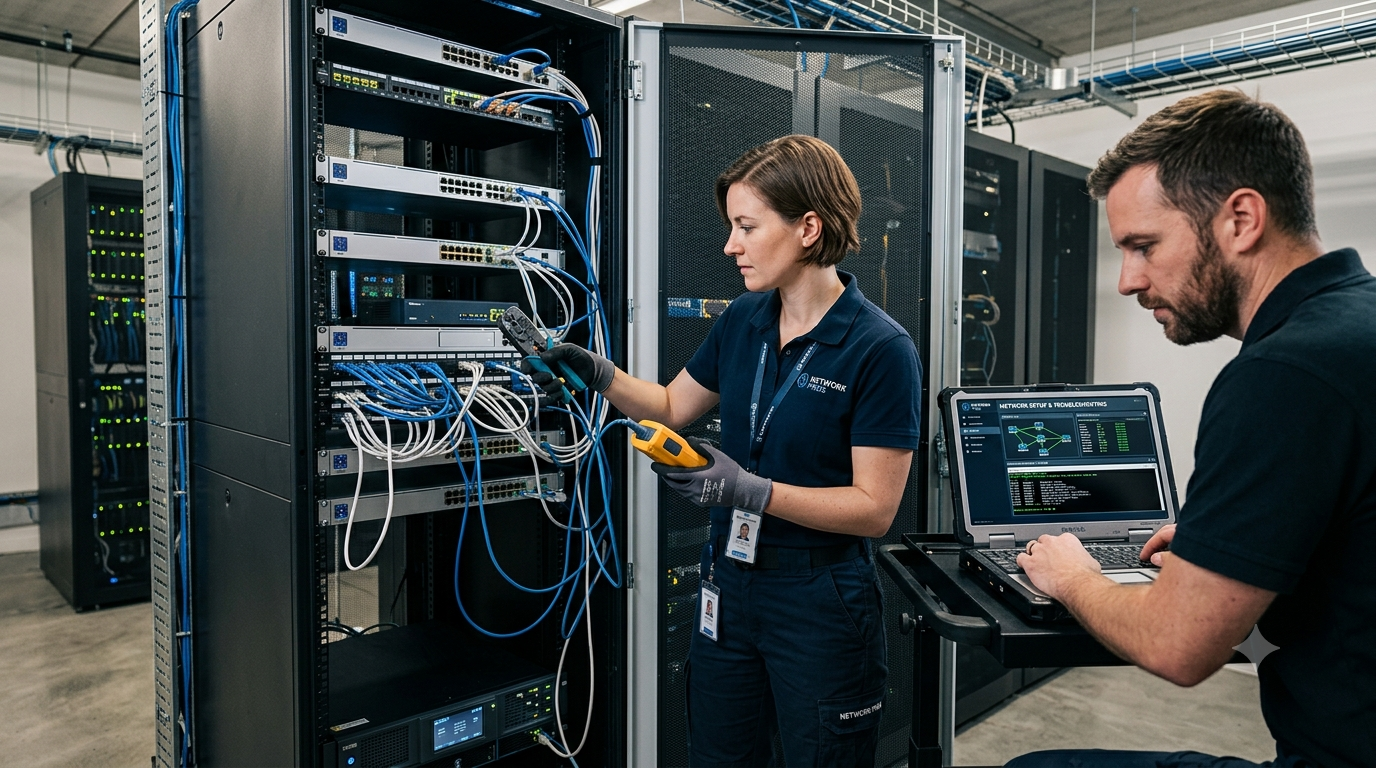
Selecting appropriate enterprise-grade hardware ensures network longevity. Unlike consumer equipment, enterprise switches, routers, and Wireless Access Points (WAPs) handle massive concurrent sessions and provide granular administration control. During physical deployment, structured cabling standards must be followed closely. Utilizing Category 6A (Cat6A) or fiber-optic lines prevents cross-talk and electromagnetic interference. Proper labeling, secure rack installations, organized patch panel management, and redundant power supplies (UPS) protect the physical tier from environmental issues.
3. Logical Architecture: Subnetting, VLAN Segmentation, and Core Routing
With physical devices installed, the logical architecture defines traffic isolation. Segmenting a network via Virtual Local Area Networks (VLANs) minimizes broadcast domains and isolates sensitive data. For instance, Corporate Users, Guest Wi-Fi, and IoT peripherals should occupy distinct VLANs. Subnetting optimizes IP address spaces, minimizing allocation waste while creating logical divisions. Next, establishing core routing protocols like OSPF (Open Shortest Path First) or BGP (Border Gateway Protocol) ensures packets take the most efficient, dynamic paths across the enterprise perimeter.
4. Implementing Comprehensive Perimeter Security
A network setup remains incomplete without strict security mechanisms. Deploying Next-Generation Firewalls (NGFW) at the edge enables deep packet inspection, intrusion prevention systems (IPS), and application-layer filtering. Furthermore, implementing the Principle of Least Privilege via Access Control Lists (ACLs) limits inter-VLAN communications to essential operational flows. Secure Remote Access via encrypted Virtual Private Networks (VPNs) or Zero Trust Network Access (ZTNA) frameworks must protect internal services from external vulnerabilities.
ENTERPRISE NETWORK TROUBLESHOOTING FRAMEWORKS
Even perfectly configured networks encounter runtime operational anomalies, component degradation, or external configuration conflicts. Managing these scenarios requires a methodical diagnostic framework rather than relying on guesswork.
1. The OSI Model Approach to Systematic Troubleshooting
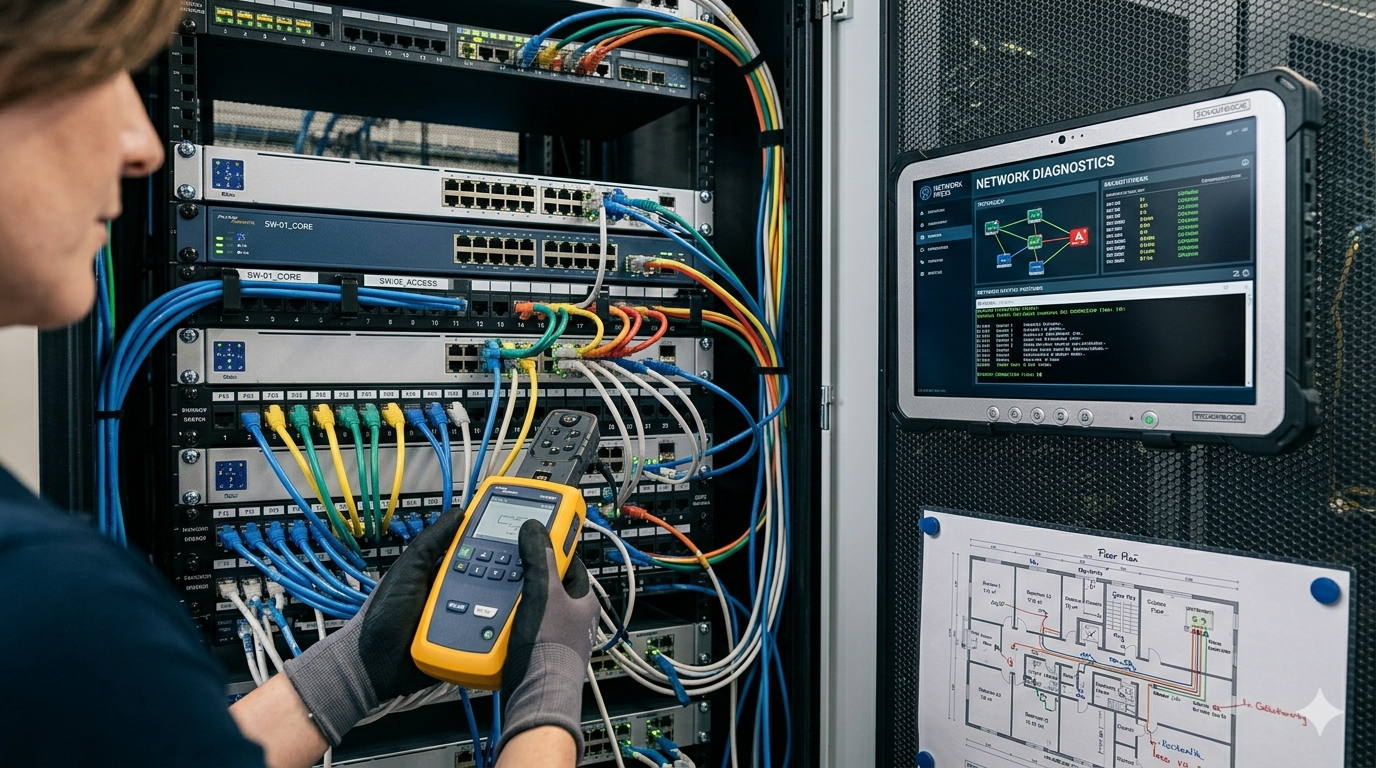
Isolating network anomalies is highly effective when structured around the Open Systems Interconnection (OSI) model. Engineers can troubleshoot from the bottom up (starting at the Physical Layer 1) or from the top down (starting at the Application Layer 7). A bottom-up approach checks physical links, cable terminations, and interface statuses before analyzing data-link errors or IP routing mismatches. This systematic verification prevents engineers from spending hours debugging software configurations when a broken patch cable is the root cause.
2. Essential Command-Line Diagnostic Tools
Command-line interface (CLI) utilities remain foundational tools for network diagnostic engineers. Resolving connectivity issues relies on an essential suite of tools:
Ping: Utilizes ICMP Echo Requests to verify end-to-end layer-3 connectivity and discover packet loss characteristics.
Traceroute / Tracert: Maps the precise routing hops a packet takes to a destination, isolating exactly which upstream gateway or router is dropping traffic.
NSLookup / Dig: Queries Domain Name System (DNS) servers to identify host resolution lags or records misconfigurations.
Netstat / IPConfig: Provides local interface IP profiles, active routing tables, and current TCP/UDP connection state machines.
3. Mitigating Common Network Anomalies
Enterprise administrators regularly face distinct performance obstacles that demand rapid remediation:
IP Address Conflicts: Occurs when two network interfaces are provisioned with identical IP hosts. Utilizing dynamic allocation via DHCP pools with configured reservation tables prevents this issue.
DNS Resolution Failures: When hostnames fail to resolve to valid IP endpoints, web access drops. Deploying redundant external DNS forwarders alongside localized caching layers mitigates this risk.
Broadcast Storms and Loop Formation: Redundant switch paths can create physical loops that degrade network performance. Enabling Spanning Tree Protocol (STP) variants ensures redundant links remain safely inactive until an active line goes down.
Continuous infrastructure visibility is critical for maintaining uptime. To review advanced strategies on performance analytics, enterprise scaling, or infrastructure health assessments, explore the diagnostic architectures developed by Dam IT Solutions LLC.
4. Proactive Performance Monitoring and Lifecycles
Modern network administration relies on proactive engineering. Utilizing Simple Network Management Protocol (SNMP) alongside telemetry data streams allows monitoring tools to track bandwidth utilization, CPU loads, and interface errors in real-time. Establishing baselines alerts administrators to anomalies before they result in widespread downtime, transforming troubleshooting from an urgent reactive task into an organized optimization workflow.
Conclusion: Scalability through Rigorous Engineering
Setting up and maintaining an enterprise network demands a balanced focus on structural design, strict security, and structured troubleshooting models. By adhering to standardized hardware layers, clear logical segmentation, and continuous telemetry monitoring, corporations can build resilient communication platforms. Partnering with dedicated infrastructure experts like Dam IT Solutions LLC helps organizations eliminate architectural blind spots, secure operational integrity, and transform complex infrastructure challenges into distinct strategic advantages.
