

Foundations, Evolution, and Infrastructure Benefits
Introduction: The Digital Backbone of Modern Business
In the contemporary corporate ecosystem, agility, scalability, and security are no longer optional luxuries; they are fundamental prerequisites for survival and growth. As businesses worldwide navigate the complexities of a highly distributed workforce and rapidly evolving market demands, the underlying IT infrastructure must adapt dynamically. At the center of this technological paradigm shift lies the integration of cloud computing and advanced communication platforms. Together, cloud and email solutions form the operational backbone of modern enterprises, enabling seamless collaboration, robust data preservation, and uninterrupted continuity.
For growing enterprises looking to establish a resilient digital footprint, choosing the right infrastructure partner is critical. Firms like Dam IT Solutions LLC provide the specialized technical expertise required to architect, deploy, and manage these sophisticated environments. By migrating legacy frameworks to unified cloud architectures, organizations can mitigate operational risks, optimize capital expenditure, and empower their workforce with the tools necessary for modern productivity.
The Evolution of Enterprise Workspace Solutions
Historically, businesses relied on on-premise servers to manage their computational workloads and local email exchanges. These legacy frameworks required heavy upfront capital investments, dedicated data center footprints, and continuous hands-on maintenance by specialized internal IT teams. Furthermore, they were inherently rigid, making scaling operations upward or downward during fluctuating economic cycles a slow, highly disruptive, and costly endeavor.
The advent of cloud computing fundamentally dismantled these operational barriers. By transitioning core infrastructure to decentralized, cloud-hosted architectures, enterprises unlocked unprecedented flexibility. Compute capacity, storage limits, and software provisioning can now be adjusted instantaneously in response to real-time market dynamics. In this new infrastructure landscape, enterprise communication systems have likewise evolved from simple, localized messaging programs into comprehensive, cloud-driven collaboration suites that aggregate voice, video, text, and document sharing into unified, accessible touchpoints.
Key Architectural Benefits of Cloud Migrations
Transitioning business operations to a cloud-managed environment delivers direct advantages that touch every tier of an organization’s operational lifecycle:
Financial Optimization: Shifting IT spend from a Capital Expenditure (CapEx) model heavily weighted toward physical hardware to an Operational Expenditure (OpEx) pay-as-you-go model allows businesses to retain liquid capital and align technology costs directly with active consumption.
On-Demand Scalability: Cloud-native architectures automatically adjust to handle volatile workloads, ensuring that system performance remains optimal during peak operational periods without requiring excessive, costly over-provisioning.
High Availability and Redundancy: Tier-IV data centers distribute enterprise data across isolated geographical zones, ensuring continuous service uptime and rapid disaster recovery even in the event of local hardware failures or natural disasters.
Elevating Communications via Advanced Cloud-Hosted Email
Email remains the definitive record of corporate correspondence, intellectual capital, and transactional data. However, standard, unmanaged email servers are increasingly poorly equipped to handle modern operational volumes and sophisticated cyber threats. Cloud-hosted email platforms solve these structural challenges by shifting communication protocols onto hyperscale server grids.
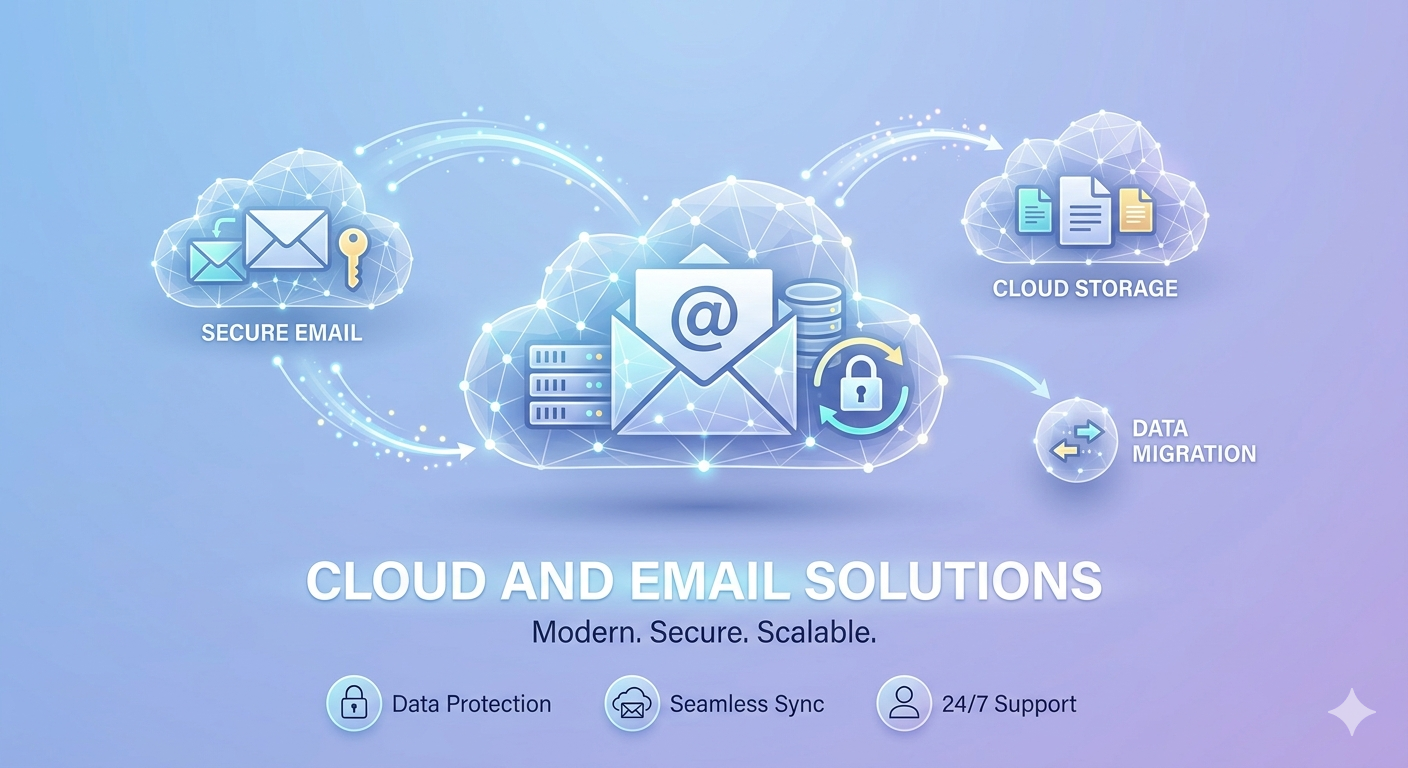
These cloud environments deliver robust data preservation capabilities through automated compliance archiving, legal hold configurations, and massive storage quotas per user. More importantly, cloud email platforms integrate deeply with everyday business applications, transforming standard inboxes into real-time collaboration engines where documents can be edited concurrently and workflows managed seamlessly from a single login interface.
Security, Compliance, Deployment, and Strategy
Fortifying the Cloud and Email Perimeter Against Modern Cyber Threats
As corporate digital perimeters expand into the cloud, they become broader targets for sophisticated cyber threats. Standard security practices are no longer sufficient to stop advanced vectors like Business Email Compromise (BEC), tailored spear-phishing campaigns, and destructive ransomware strains. Securing this distributed operational surface demands a layered defense strategy that treats identity as the new corporate perimeter.
To establish a truly resilient defense posture, enterprises must partner with dedicated IT consultants. By engaging with trusted specialists like Dam IT Solutions LLC, corporations can systematically implement enterprise-grade security structures. Foremost among these defenses is Multi-Factor Authentication (MFA), which adds vital verification layers beyond simple passwords. This is reinforced by AI-driven filtering protocols that analyze incoming message metadata in real time to isolate and neutralize zero-day malicious payloads before they ever reach an employee’s inbox. Concurrently, data loss prevention (DLP) rules must be established to monitor outgoing data, blocking the accidental or malicious transmission of proprietary intellectual property and sensitive customer financial records.
Business Continuity, Disaster Recovery, and Regulatory Compliance
Data loss, whether caused by malicious actors, human error, or unexpected physical infrastructure failures, can severely disrupt business operations and cause lasting financial damage. Because cloud environments decouple company data from specific physical office hardware, they provide an ideal foundation for building highly reliable business continuity plans.
Modern cloud and email architectures use continuous, real-time replication to back up data across multiple distinct geographical regions. If an emergency occurs at a primary office location, operations can quickly fail over to cloud backups, keeping downtime close to zero. Furthermore, for businesses operating in tightly regulated industries like healthcare, finance, or legal services, modern cloud solutions offer built-in compliance frameworks that naturally align with stringent standards such as HIPAA, GDPR, and SOC 2. These tools automate data retention policies, encrypt sensitive records both in transit and at rest, and maintain detailed, tamper-proof audit trails required by regulatory inspectors.
Strategic Planning for Seamless Infrastructure Migrations
While the long-term operational and financial benefits of moving to cloud-hosted email and IT systems are clear, executing the transition requires careful, deliberate planning. A poorly planned migration can trigger data loss, corrupt mail databases, and cause unexpected downtime that hurts employee productivity and damages customer trust.
A successful transition relies on a structured, multi-phase migration methodology:
Discovery and Audit: A comprehensive evaluation of the existing legacy software stack, local network bandwidth limitations, data storage profiles, and third-party software dependencies.
Architectural Coexistence Design: Building a secure hybrid environment that allows legacy internal systems to communicate cleanly with new cloud services, enabling a gradual, phased user migration rather than a risky all-at-once cutover.
Secure Data Ingestion: The systematic delta-syncing of historical mail repositories, complex file structures, and user permissions into the secure cloud environment without disrupting live operations.
Validation and User Optimization: Comprehensive testing of mail routing rules, security policies, and mobile endpoints, combined with structured staff training to maximize software adoption.
Conclusion: Partnering for Long-Term Digital Success
The integration of scalable cloud platforms and secure email solutions is a fundamental requirement for any business aiming to compete in today’s digital economy. Embracing these cloud-driven tools allows companies to replace rigid, high-maintenance legacy systems with an agile, secure infrastructure built for growth and collaboration.
However, navigating the complex world of cloud licensing, data security, and system migration can be difficult without dedicated expertise. Businesses can simplify this journey by working with experienced technology professionals like Dam IT Solutions LLC. Their expert teams handle the complexities of cloud architecture design, seamless data migration, and proactive security management. This allows business leaders to step away from daily IT troubleshooting and focus their energy on core strategic initiatives, confident that their digital foundation is stable, safe, and ready for the future.
