
The Blueprint of Network Reliability: An Architectural Guide to Cable Testing and Labeling
Introduction: The Foundation of Modern Data Infrastructure
In the contemporary digital landscape, enterprise operations are entirely dependent on the seamless, uninterrupted transmission of data. While businesses invest heavily in next-generation switches, high-throughput firewalls, and complex cloud-hybrid architectures, the foundational physical layer often remains neglected. The physical layer—specifically the structured cabling system—is the literal central nervous system of any enterprise network. Software bugs can be patched remotely and misconfigured servers can be updated via a cloud management console, but a physically failing or unidentifiable cable requires direct, manual intervention, often leading to costly operational downtime.
According to industry metrics, more than half of all unexpected network failures originate at the physical layer. These issues frequently present themselves as intermittent packet loss, sudden speed bottlenecks, or complete hardware disconnects. To prevent these vulnerabilities from disrupting business workflows, implementing an uncompromising protocol for testing and identification is non-negotiable. Enterprise IT integration specialists, such as Dam IT Solutions LLC, emphasize that systematic verification and meticulous record-keeping during installation are the primary defenses against unpredictable physical infrastructure failures.
The Engineering Mechanics of Comprehensive Cable Testing
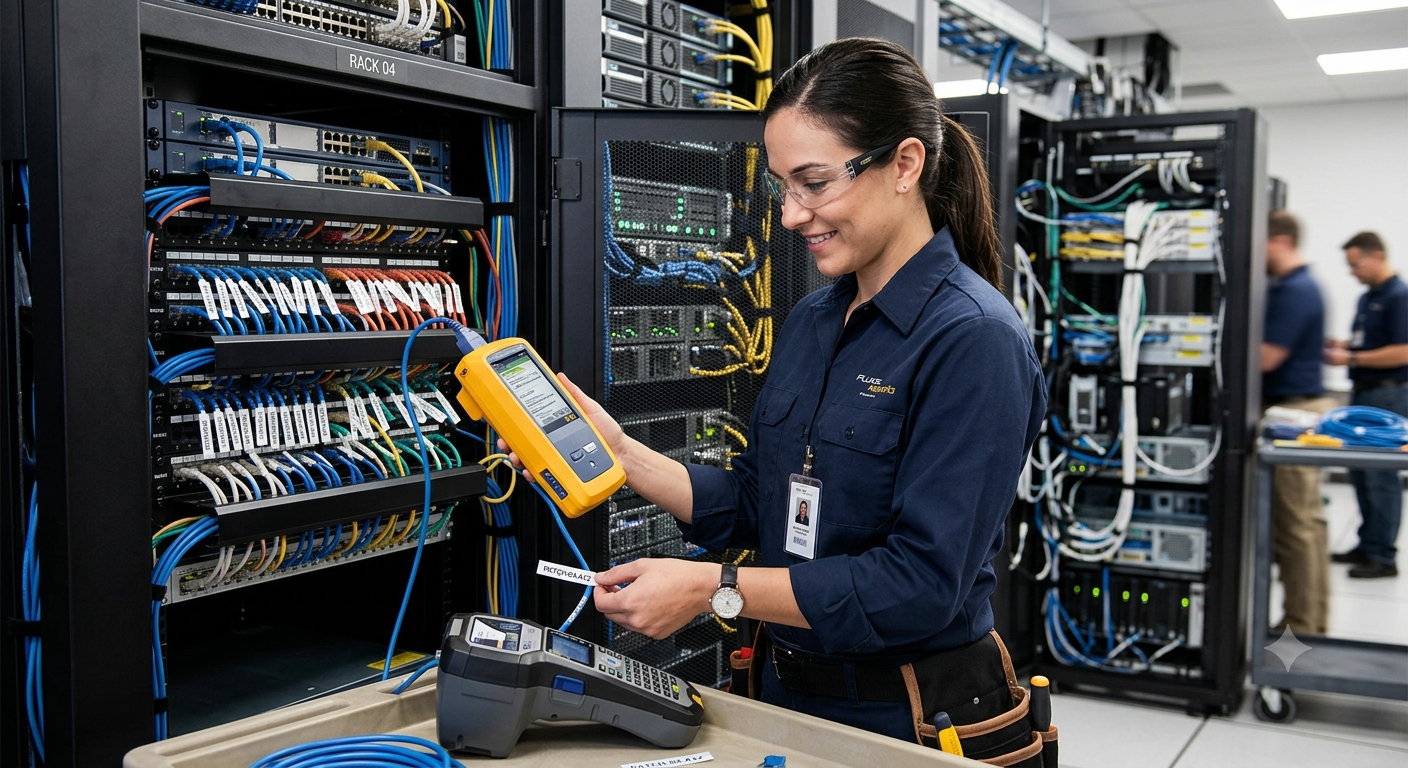
Cable testing is not merely a process of ensuring a line is plugged in on both ends; it is a multi-tiered validation architecture that guarantees copper or fiber media can support high-speed data transmission profiles without signal degradation. Depending on the deployment phase and operational requirements, physical layer testing is divided into three distinct operational methodologies: Verification, Qualification, and Certification.
1. Verification: Basic Continuity Testing
Verification is the initial operational line of defense. Utilizing wiremap testers, this process checks the physical integrity of the copper conductors within a Category 6 (Cat6) or Category 6A (Cat6A) assembly. Verification confirms that all eight conductors are terminated to the correct pins on both ends (RJ45 connectors or IDC punch-down blocks). This tier identifies fundamental installation defects such as:
Open Circuits: Conductors that are broken or poorly punched down, preventing electrical current from traveling across the channel.
Short Circuits: Exposed copper wires touching one another inside the jacket or connector casing, causing improper electrical loops.
Split Pairs: A subtle installation error where a wire from one twisted pair is incorrectly matched with a wire from an entirely different pair, severely disrupting the electromagnetic balance required for noise cancellation.
2. Qualification: Bandwidth Capabilities Assessment
Qualification tests determine whether an existing physical infrastructure can support specific network technologies or speeds, such as 1000BASE-T (Gigabit Ethernet) or 10GBASE-T (10-Gigabit Ethernet). Qualification tools generate actual network traffic profiles and push them across the cable run to monitor packet transmission integrity. This process determines if a cable can handle the signaling frequencies of specific network configurations without throwing errors, making it an essential phase during infrastructure audits and legacy hardware modernizations.
3. Certification: Strict Industry Standard Compliance
Certification is the most demanding and legally recognized tier of cable testing. It requires specialized, calibrated diagnostic instruments to verify that a structured cabling link complies with rigorous industry benchmarks established by the Telecommunications Industry Association (TIA) and the International Organization for Standardization (ISO). Certification tools do not merely pass traffic; they measure exact electrical performance metrics across predefined frequency spectrums (up to 500 MHz for Cat6A, and up to 2000 MHz for Cat8).
A certified installation provides quantitative analytical proof of performance. Key metrics measured during this phase include:
Insertion Loss (Attenuation): The natural reduction in signal strength as it travels down the length of the link. It ensures the signal remains strong enough to be interpreted by receiving hardware.
Near-End Crosstalk (NEXT): The measure of unwanted signal coupling between adjacent wire pairs inside the same cable jacket, measured at the end where the signal is generated. High NEXT values indicate poor termination practices or crushed wire pairs.
Return Loss: The measurement of signal reflections sent back toward the transmitter, caused by structural variations or impedance mismatches in the copper core.
When engineering teams like Dam IT Solutions LLC deploy enterprise network environments, every link undergoes rigorous certification testing, with data logs compiled into an analytical deliverable for structural validation and warranty activation.
Strategic Cable Labeling and Documentation Architecture
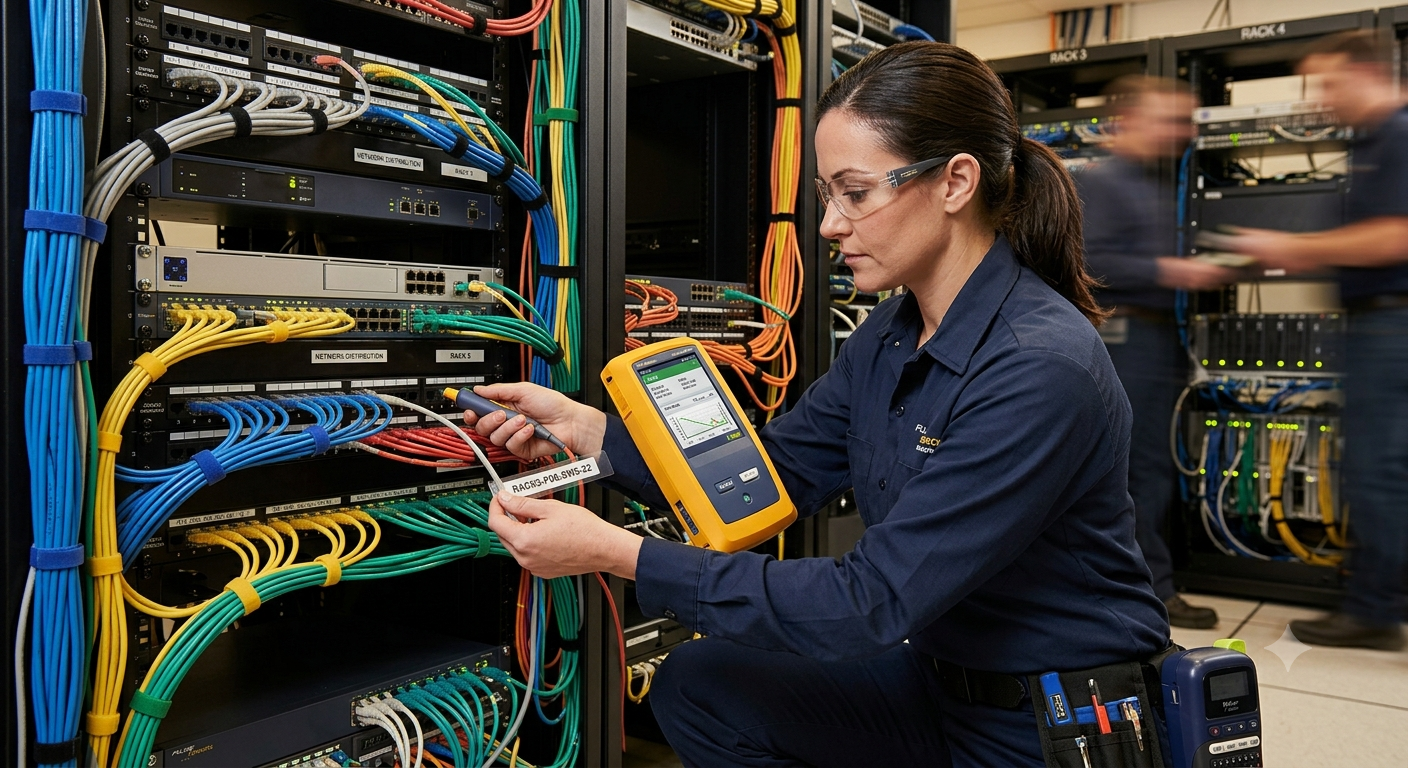
If cable testing represents the performance verification of a network, cable labeling represents its operational roadmap. In a clean, newly built server room containing fifty drops, keeping track of cables is straightforward. However, as organizations scale, that footprint can expand into thousands of terminations distributed across cross-connects, core switching fabrics, and remote intermediate distribution frames (IDFs). Without an immutable, logical nomenclature scheme, maintenance routines quickly deteriorate into chaotic, costly troubleshooting cycles.
The TIA-606-C Standard Hierarchy
To avoid fragmented, proprietary labeling styles, the industry relies on the TIA-606-C Telecommunications Infrastructure Administration Standard. This guideline outlines a strict, standardized identification syntax applicable across all infrastructure components. A typical enterprise tracking label follows a distinct structural hierarchy:
Floor & Telecommunications Room Location: Identifies the precise architectural zone where the cable originates or terminates (e.g.,
1Afor 19th Floor, Closet A).Rack and Patch Panel Coordinates: pinpoints the physical cabinet rack and the specific panel alignment containing the equipment ports.
Port Number: Designates the exact structural jack assigned to that connection sequence (e.g.,
Port 24).
By implementing this structured format at both the server rack patch panel and the corresponding workstation wall outlet, field technicians can instantly trace a drop across an entire facility without running intrusive tone tests or disrupting production environments.
Material Engineering in Industrial Labeling
Effective labeling requires durable, specialized materials engineered for enterprise server room conditions. Using generic paper tape or consumer-grade adhesives leads to peeling, yellowing, and unreadable text over time due to the constant heat generated by hardware racks. Professional installation methodologies use industrial materials suited for long-term cable management:
Self-Laminating Vinyl Labels: Featuring a printed text section and a clear, wrap-around tail that seals the printed area, these labels protect against moisture, friction, and heat.
Discount LabelsHeat-Shrink Polyolefin Tubes: Slipped onto the conductor before termination and shrunk using a heat gun, these tubes provide an airtight, permanent label that will not slip or degrade over the lifespan of the deployment.
Color-Coded Identification Matrixes: Utilizing distinct colors across the infrastructure creates immediate visual segregation for different sub-networks. For instance, blue cabling can indicate standard corporate data lines, yellow can represent VoIP telephone lines, red can denote secure IP security camera feeds, and white can be reserved for building automation systems.
Conclusion: Maximizing Return on Investment via Infrastructure Optimization
The operational value of integrating comprehensive cable certification alongside structured asset labeling is realized throughout the entire functional lifecycle of an enterprise network. When emergency outages or hardware faults occur, a properly labeled environment allows support technicians to isolate, patch, and replace affected infrastructure segments within minutes rather than hours. This proactive approach significantly reduces Mean Time to Repair (MTTR), protects critical revenue streams, and lowers total cost of ownership.
Furthermore, certified structured cabling assets protect an enterprise investment during hardware upgrades. As switching frameworks transition from Gigabit links to advanced Multi-Gigabit networks, certified physical cable infrastructures eliminate the need for expensive, disruptive rip-and-replace deployments. Partnering with professional infrastructure specialists like Dam IT Solutions LLC ensures that your physical layer is fully tested, thoroughly documented, and prepared to handle future technological expansions.
