
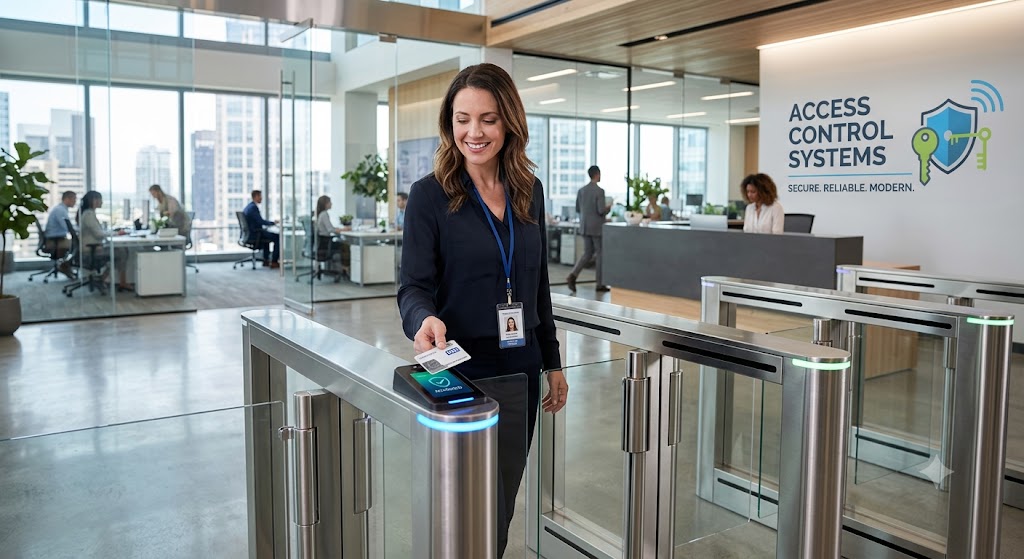
In today’s interconnected and fast-paced commercial landscape, security is no longer a passive measure restricted to physical locks and security personnel. As organizations scale, the complexity of managing physical spaces, safeguarding intellectual property, and ensuring employee safety multiplies exponentially. Modern access control systems represent the first line of defense in an integrated enterprise security posture. By shifting from mechanical key-based locking systems to software-driven, network-managed infrastructure, companies can establish granular control over who enters their facilities, when they gain entry, and which specific zones they are permitted to navigate.
Implementing a robust physical security framework requires a strategic synergy between cutting-edge hardware and highly responsive IT infrastructure. This technical integration is precisely where expert intervention becomes invaluable. Companies like Dam IT Solutions LLC specialize in bridging the gap between traditional structural security and advanced network architectures, ensuring that your facility’s physical checkpoints seamlessly feed security telemetry directly into core business operations.
2. Key Components of an Access Control Framework
An enterprise-grade access control solution relies on a synchronized ecosystem of distinct components categorized into three operational layers: authentication inputs, processing infrastructure, and physical locking mechanisms.
Authentication Inputs (Credentials and Readers): The system relies heavily on credentials to verify identity. Traditional plastic physical keys have evolved into high-frequency RFID smart cards, mobile credentials powered by Bluetooth Low Energy (BLE) or Near Field Communication (NFC), and biometric modalities such as fingerprint scanning, iris scanning, and facial recognition technology. Readers installed at entry points capture these credentials and instantly transmit the encoded payload data down the line for system authentication.
Processing Infrastructure (Controllers and Management Software): The controller serves as the local brain of an access point. It is an IP-enabled hardware panel that stores localized access privileges. When a card is scanned, the controller evaluates the access request against pre-configured system rules. The management software sits on top of this hardware cluster, providing a centralized interface where system administrators can assign clearances, track real-time audit logs, modify scheduling rules, and instantly lock down facilities during active threat scenarios.
Physical Locking Mechanisms: Once access is successfully validated, the controller signals an output relay to change the physical state of the barrier. This relies on specialized electronic locks, such as electromagnetic locks (maglocks) which utilize powerful magnetic fields, or electric strikes that drop a physical latch when energized. Selecting the right physical hardware requires deep technical consideration of structural fail-safe or fail-secure operational criteria.
3. Authentication Technologies: Choosing the Right Modality
Choosing the correct credential type involves analyzing the trade-offs between physical security, administrative overhead, and user convenience. Traditional proximity cards (125 kHz) are increasingly phased out due to critical vulnerability to cloning and exploitation. Forward-looking security teams are transitioning to smart cards utilizing advanced AES encryption standards to stop credential skimming attacks.
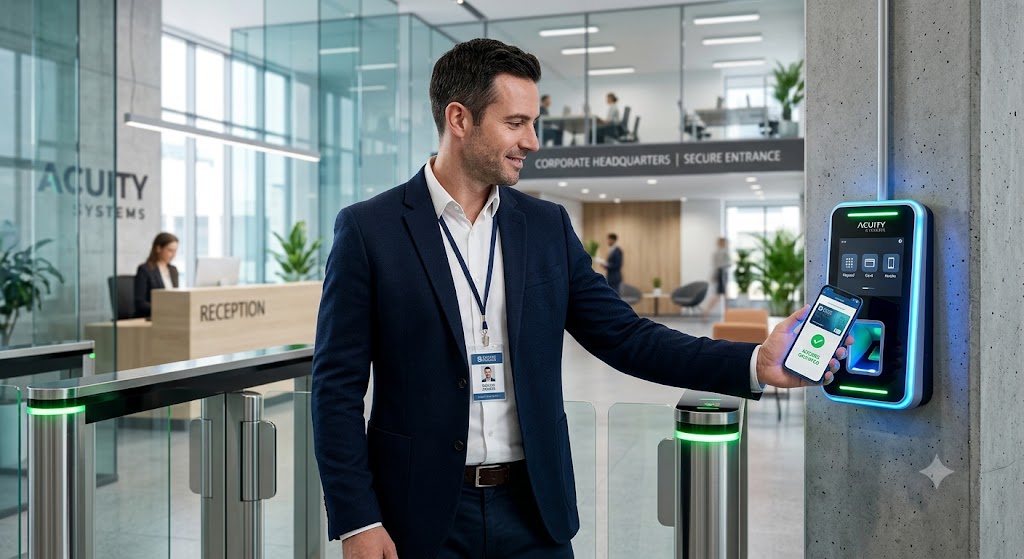
Concurrently, mobile credentials have seen widespread corporate adoption. Leveraging smartphone hardware reduces card procurement costs and minimizes risks associated with lost credentials, as employees naturally protect their phones. Biometrics represent the absolute pinnacle of individual accountability by eliminating credential sharing entirely. However, biometric deployment demands meticulous compliance with regional data privacy frameworks to guarantee secure handling of sensitive algorithmic user templates.
Deployment, Integration, and Strategy
4. Network Architecture and IP-Based Control Systems
The shift from legacy analog serial wiring (RS-485) to native, IP-based network architectures has revolutionized physical security management. Contemporary access controllers connect directly to local corporate networks via standard Ethernet cables, leveraging Power over Ethernet (PoE) to deliver power to the controller and the attached electric lock over a single network run. This approach dramatically reduces electrical infrastructure costs and accelerates system installation timelines.
Moving your security architecture to the network edge brings infrastructure oversight directly under the domain of the enterprise IT department. Consequently, systems must be hardened against standard network threats. Security administrators must enforce end-to-end encryption protocols (such as TLS 1.3) for all controller-to-server traffic, segregate security hardware onto dedicated virtual local area networks (VLANs), and mandate rigorous 802.1X network authentication. Partnering with seasoned network infrastructure experts like Dam IT Solutions LLC guarantees that your physical security systems are fully optimized, monitored, and thoroughly protected against evolving cybersecurity threats.
5. Converging Physical Security with Corporate IT Systems
An access control system should never exist as an isolated silo. True operational efficiency is unlocked when access control is deeply integrated across your broader IT ecosystem. Through open application programming interfaces (APIs), access events can instantly trigger video recording on network-attached cameras, allowing security operators to visually confirm identity matches during anomalies.
Furthermore, integrating access software with your corporate Identity and Access Management (IAM) suite—such as Microsoft Active Directory or Okta—simplifies employee onboarding and offboarding. When an HR manager deactivates an employee’s digital account, their physical badge permissions are stripped in real time across all properties. This immediate convergence closes a massive security loophole, completely preventing former employees from accessing physical office premises after termination.
6. Strategic Best Practices for Enterprise Implementation
Deploying a comprehensive system successfully requires careful, phase-based planning. Organizations must start by conducting a thorough, physical site threat assessment to pinpoint structural vulnerabilities, define traffic flow, and categorize zones based on their specific risk profiles. A tiered security architecture ensures that general staff credentials handle main office access, while dual-factor authentication controls high-value targets like server infrastructure and financial records rooms.
Additionally, regulatory frameworks like HIPAA, PCI-DSS, and SOC 2 require detailed, immutable audit trails. Modern platforms automate this compliance by tracking all access attempts and modifications, making it easy to generate clean reports during external compliance audits. Finally, scheduling regular preventative maintenance, evaluating lock alignment, and conducting penetration testing of the underlying IT network will ensure your defenses remain fully operational over time.
7. Conclusion: The Future of Workspace Protection
Physical access control systems are rapidly evolving into intelligent environments that optimize workspace efficiency and protect corporate assets. As technologies like AI-driven pattern analysis and cloud-managed infrastructure become the industry standard, the line between software security and physical asset protection will continue to blur.
Securing this landscape demands a comprehensive approach that unites reliable physical infrastructure with advanced network defense. By working with dedicated technical integrators like Dam IT Solutions LLC, your business can deploy an agile, scalable access control framework tailored to meet today’s security demands while confidently scaling for tomorrow’s challenges.
