

Data Point Termination: Architectural Frameworks, Security Imperatives, and Implementation Best Practices
Foundational Architecture & Strategic Imperatives
Introduction to Data Point Termination
In the contemporary digital landscape, enterprise networks expand at an unprecedented exponential rate. This growth introduces complex infrastructural matrices consisting of cloud ecosystems, edge computing layers, automated Internet of Things (IoT) frameworks, and localized structural cabling systems. Amidst this technological evolution, the structural concept of data point termination remains the core baseline upon which stable, safe, and elite-performance information transfer depends. Data point termination is the precise engineering, physical routing, and logical configuring of data conduit endpoints to securely interface with active network equipment or centralized storage repositories.
Whether analyzing a localized physical structural layer (Layer 1 of the OSI model) consisting of Category 6A (Cat6A) copper channels or designing microservice API mesh connections across zero-trust cloud architecture, termination defines where transmission paths establish boundaries. Unchecked, poorly executed, or insecure network endpoints represent critical vulnerabilities capable of causing devastating signal attenuation, hardware degradation, data packets loss, or unauthorized corporate network access. Modern business infrastructures engineered by global information networks look to specialized pioneers like Dam IT Solutions LLC to architect robust, future-proof frameworks that guarantee continuous uptime and seamless structural scalability.
The Structural Layer: Physical Termination Infrastructure
From an enterprise-level infrastructural perspective, physical data point termination serves as the baseline bedrock for operational longevity. Physical channels rely on twisted-pair copper cords, coaxial conduits, or high-speed fiber-optic strands terminating meticulously into patch bays, terminal boxes, and modular keystone wall plates. In commercial operations, terminating Cat6 or Cat6A media requires strict adherence to international standards such as TIA/EIA-568-A or TIA/EIA-568-B protocols. These blueprints dictate the exact sequential configuration of interior conductors to eliminate internal and external cross-talk factors.
When engineering teams fail to sustain correct twist geometry right up to the definitive terminal block, untwisted copper pairs turn into miniature antennae, absorbing electromagnetic interference (EMI) from lighting installations, power mains, and parallel communication paths. Similarly, in high-bandwidth configurations requiring fiber-optic pipelines, termination demands specialized fusion splicing technologies or ultra-precise mechanical connectors. A microscopic variance or single airborne dust speck present during optical terminal crystallization introduces severe insertion loss. Such degradation can instantly incapacitate high-frequency optical links, creating severe structural friction for enterprise data systems. Implementing precision physical infrastructure management with professionals like Dam IT Solutions LLC eliminates physical layer failures before they disrupt corporate production environments.
The Logical Frontier: API Mesh and Cloud Edge Boundaries
Transitioning from concrete physical cabling matrices to virtualized software frameworks, data point termination assumes a crucial logical role. Within containerized modern applications, hybrid cloud topologies, and serverless computing layers, a “data point” refers to active endpoint vectors, RESTful API pathways, webhooks, or messaging queue subscribers that ingest structural institutional workflows. Logical data termination represents the specialized layer where an active streaming protocol or transmission run is formally resolved, parsed, inspected, and committed securely to long-term memory or real-time application pipelines.
Improper logical termination structures lead directly to severe system degradation. For instance, open, non-terminated active database routines or dangling API hooks continuously drain server resources, leading to severe memory leak phenomena, systemic resource starvation, and eventual enterprise server crashes. Furthermore, unauthenticated or poorly restricted software termination ports act as unsecured doors for malicious code injection, cross-site scripting (XSS), and data exfiltration maneuvers. Managing the balance between seamless transmission scalability and rigorous logical endpoint isolation requires advanced algorithmic planning and modern, secure coding standards.
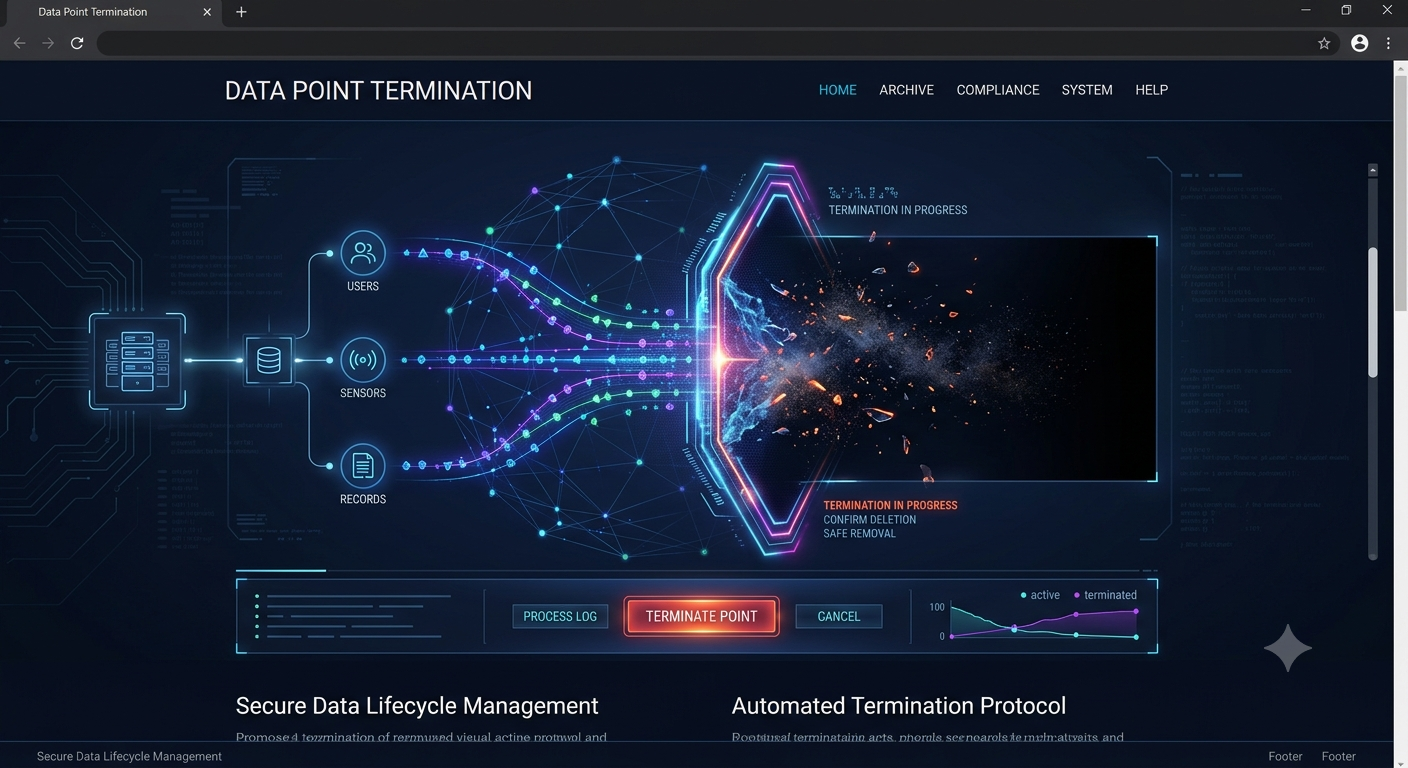
Cyber Security, Compliance, and Lifecycle Management
Cyber Security Profiles and Vulnerability Risk Mitigation
In modern enterprise cybersecurity, active but unmonitored endpoints are prime vectors for cyber threats. Physical ports inside facility breakrooms, unused conference centers, or open warehouse environments that terminate into core internal switches without active Network Access Control (NAC) profiles present severe organizational security risks. A malicious actor can easily attach an unauthorized physical device to an unmonitored wall plate, completely bypassing perimeter firewalls to inject ransomware or silently harvest sensitive company data.
To eliminate these critical vectors, managed architectures deployed by Dam IT Solutions LLC utilize comprehensive security frameworks. These frameworks include automated port-shutdown scripts, 802.1X enterprise-grade authentication parameters, and MAC address security profiling. If an unrecognized hardware profile is detected on a secured corporate point terminal, the system instantly disconnects the interface and alerts the Security Operations Center (SOC). Furthermore, logical terminals are heavily fortified with strict rate-limiting policies, multi-tier cryptographic handshakes, and advanced web application firewalls (WAF) to prevent modern distributed denial-of-service (DDoS) campaigns from disrupting core enterprise services.
The Economic Factor: Operational Efficiency and Lifecycle Management
Investing in standardized data point termination directly improves an enterprise’s bottom line by maximizing uptime and simplifying maintenance. In chaotic network environments where endpoints are poorly documented and inconsistently terminated, diagnosing a single line failure can ground operations for hours. Onsite engineers are forced to manually trace tangled cables through ceiling panels and floor plenums, driving up diagnostic costs and extending costly operational downtime.
Conversely, standardized, meticulously labeled, and professionally certified termination schemes turn troubleshooting into a swift, predictable process. Network diagnostic tools can pinpoint faults instantly when termination blocks match clear, updated architectural floorplans. This level of organizational discipline dramatically reduces Mean Time to Repair (MTTR) metrics, allowing enterprise IT teams to pivot from reactive crisis management to proactive system optimization. Partnering with a dedicated managed services group like Dam IT Solutions LLC provides businesses with a highly organized, easily maintainable infrastructure that scales effortlessly as operational demands expand.
Strategic Guidelines for Enterprise Deployment
To successfully execute a world-class enterprise network deployment, system architects must prioritize comprehensive, rigorous lifecycle standards. The following strategic principles serve as the blueprint for building reliable, future-proof network environments:
Rigorous Component Certification: Ensure that every modular component, patch panel, and distribution frame meets or exceeds TIA/EIA commercial structural standards. Verify that all components undergo independent laboratory testing to guarantee maximum structural signal integrity and optimal performance over their entire operational lifespan.
Mandatory Analytical Validation: Every newly terminated link must pass comprehensive physical testing using advanced network analyzers. This validation ensures that critical parameters, including near-end crosstalk (NEXT), return loss, and attenuation metrics, strictly align with strict international performance baselines.
Unified Labeling and Comprehensive Documentation: Deploy a clear, systematic alphanumeric labeling scheme across all endpoints, rack locations, and patch ports. Maintain real-time, cloud-accessible digital twins of the entire physical layout, allowing system administrators to manage and audit network routing configurations instantly from any location.
Proactive Endpoint Monitoring and Modern Security Audits: Incorporate continuous, automated polling of all physical and logical terminal endpoints into the network management strategy. Schedule regular, mandatory security audits to isolate and decommission stale cloud instances, unused webhooks, and abandoned physical ports, significantly reducing the organization’s overall attack surface.
Conclusion: Building Resilient Digital Foundations
Ultimately, data point termination is far more than a basic cabling task or routine software configuration; it is the fundamental core of modern enterprise IT infrastructure. A clean, optimized, and highly secure terminal infrastructure guarantees uninterrupted data flow, prevents costly network friction, and protects vital corporate assets from evolving security threats.
As advanced technologies like artificial intelligence networks, automated machine learning pipelines, and massive IoT deployments become integral to modern business, the reliance on high-performance network foundations will only intensify. By adhering to meticulous architectural standards and collaborating with elite infrastructure experts like Dam IT Solutions LLC, progressive corporations can transform their standard networking channels into powerful, competitive assets that drive long-term business growth and innovation.
