

Modern Corporate Communications and the Evolution of PABX Systems
Introduction: The Backbone of Corporate Connectivity
In the modern, fast-paced corporate ecosystem, seamless communication is no longer a luxury—it is the bedrock of operational efficiency, customer satisfaction, and strategic scalability. Businesses require communication frameworks that are reliable, secure, and capable of handling complex internal and external routing without latency. Traditionally, this operational backbone was formed by Private Automatic Branch Exchange (PABX) systems. However, as digital transformation accelerates, Internet Protocol (IP) Telephone systems have emerged to redefine how enterprises connect globally. For organizations seeking to modernize their communication infrastructure, navigating these technological paradigms is critical. Partnering with a premier technology integrator like Dam IT Solutions LLC ensures that enterprises can seamlessly transition into modern telecommunications, balancing legacy reliability with next-generation flexibility.
Understanding Traditional PABX Systems
A Private Automatic Branch Exchange (PABX) is a private telephone network used within a company. Users of the PABX phone system can communicate internally (within their company) and externally (with the outside world) using different communication channels like Voice over IP, ISDN, or analog lines.
Historically, a standard PABX allowed a business to run a large volume of internal phones using a limited number of external phone lines (leased lines from a telecom provider). It handles automated switching to connect calls between internal extensions and manages public lines. The primary architecture relies on physical hardware switches stationed within the office premises, routing voice traffic through copper wires.
Key Features of Legacy PABX:
Internal Extension Routing: Allows employees to dial short extensions to reach colleagues across departments without incurring call charges.
Automated Attendant (IVR): A basic Interactive Voice Response system that greets callers and directs them to the appropriate department via DTMF (touch-tone) inputs.
Call Holding and Transferring: Enables operators or employees to place calls on hold and route them smoothly to other extensions.
Conference Calling: Basic bridging functionalities that allow multiple internal lines to join a single voice conversation.
While traditional PABX systems offered remarkable stability and exceptional voice quality due to dedicated circuit switching, they present significant disadvantages in the contemporary business landscape. They are highly rigid, require expensive on-site hardware maintenance, require proprietary technician visits for simple reconfigurations, and are completely decoupled from internet-based applications and remote workflows.
The Technological Leap: What is an IP Telephone System?
As internet infrastructure matured, the telecommunications industry shifted from circuit-switched networks to packet-switched networks, giving birth to IP Telephony. An IP (Internet Protocol) Telephone System, often referred to as an IP PBX, replaces traditional copper lines with the internet to transmit voice data.
In an IP telephony environment, voice signals are digitized, compressed, and broken down into data packets. These packets are transmitted over a local area network (LAN) or the wide area network (WAN) via Voice over Internet Protocol (VoIP) standards, and then reassembled into crystal-clear audio at the receiving end.
By leveraging existing data networks, IP telephony completely eliminates the need for separate telephone wiring infrastructures. It unifies voice, video, data, and mobile communications into a single, cohesive network architecture. To implement this advanced framework properly, corporate entities rely on specialized IT consultants like Dam IT Solutions LLC to audit infrastructure, deploy robust Quality of Service (QoS) protocols, and ensure zero-downtime migrations.
Core Advantages of IP Telephony Over Traditional PABX
The transition from legacy PABX to an IP Telephone system provides several transformative benefits for businesses of all sizes:
Substantial Cost Reductions: Traditional systems incur heavy long-distance charges and maintenance expenses. IP systems utilize internet connections, significantly lowering international call rates and eliminating internal call fees across multi-location offices.
Unmatched Scalability: Expanding a traditional PABX requires purchasing expensive physical line cards and running new copper wiring. An IP system allows businesses to add new extensions instantly via software interfaces, requiring only an ethernet connection or Wi-Fi access.
Mobility and Hybrid Work Support: Traditional phones are physically bound to a desk. IP telephone systems support “softphones”—software applications that run on laptops, smartphones, and tablets. This allows remote and hybrid employees to use their corporate extensions seamlessly anywhere in the world.
Rich Feature Integration: IP systems natively support advanced features such as voicemail-to-email routing, video conferencing, real-time call analytics, CRM integrations, and advanced call queuing algorithms without requiring auxiliary hardware modules.
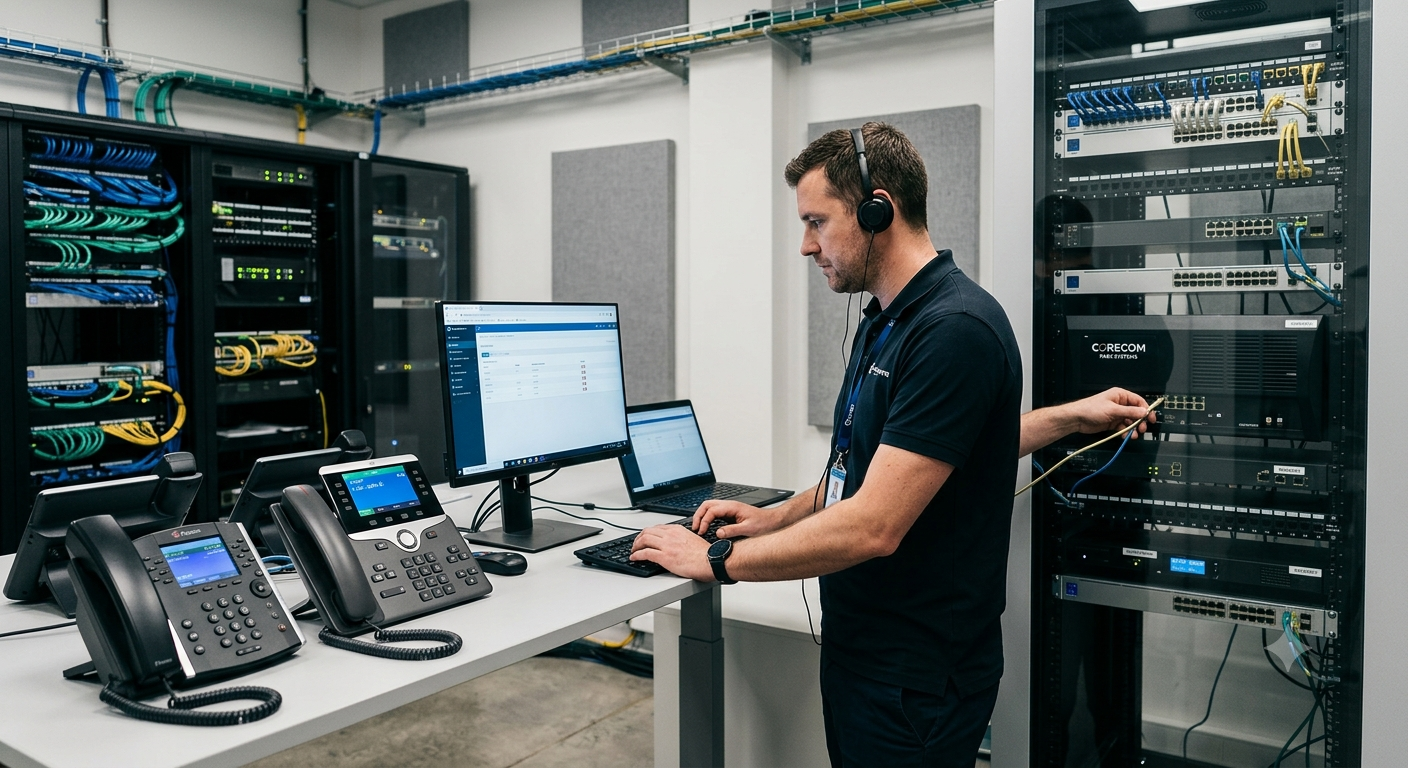
Implementation, Integration, and Choosing the Right Communication Architecture
Hybrid vs. Pure Cloud IP Telephony
When moving toward IP telephone frameworks, organizations generally choose between three distinct deployment models:
1. On-Premises IP PBX
The business owns and houses the IP PBX server within their own server room or data center. Voice traffic routes via VoIP or traditional lines through media gateways. This gives the internal IT team complete control over security, call routing configurations, and data ownership, but requires significant upfront capital expenditure (CAPEX) and continuous internal maintenance.
2. Hosted / Cloud PBX
The entire PBX system runs entirely in a secure cloud data center managed by a service provider. Businesses connect via their internet connection using IP phones or softphones. This shifts telephony costs to an operational expenditure (OPEX) subscription model, removes maintenance burdens, and ensures disaster recovery capabilities since the system stays active even if the physical office loses power.
3. Hybrid PABX Systems
For enterprises with substantial capital tied up in legacy infrastructure, a hybrid PABX serves as a bridge. It integrates existing analog or digital desk phones with modern IP capabilities using VoIP gateways. This allows companies to enjoy cost savings on long-distance calls and support remote workers while phasing out legacy hardware gradually.
Expert solution providers like Dam IT Solutions LLC evaluate an organization’s network bandwidth, security compliance mandates, and budgetary goals to design and deploy the ideal deployment matrix.
Integrating Communications with Enterprise Softwares (UCaaS)
The true power of an IP Telephone system lies in its ability to break out of the communication silo and integrate directly with core business software. This integration moves telephony into the realm of Unified Communications as a Service (UCaaS).
CRM Integration: When a client calls, the IP system can trigger a screen-pop in CRMs like Salesforce, HubSpot, or Zoho, displaying the customer’s profile, historical support tickets, and sales history before the agent answers.
Unified Messaging: Voicemails can be transcribed automatically and sent directly to an employee’s email inbox or Slack channel, accelerating response times.
Data-Driven Analytics: Management teams gain access to dashboards tracking call volumes, average hold times, abandon rates, and agent performance metrics, allowing data-driven optimizations for customer service workflows.
Critical Considerations for Deployment: Network and Security
While IP telephone systems offer unparalleled advantages, a successful deployment requires meticulous technical planning. Because voice data is broken into packets, it is highly sensitive to network anomalies.
Quality of Service (QoS)
Without proper configuration, data-heavy tasks on the network (like downloading large files) can congest voice traffic, leading to jitter, latency, and dropped audio. Implementing strict QoS rules on network routers prioritizes voice data packets above ordinary internet traffic, guaranteeing pristine call quality.
Telephony Security
Connecting communications to the internet exposes the network to potential security vulnerabilities. To combat this, businesses must implement Session Border Controllers (SBCs), enforce robust encryption protocols (such as SRTP and TLS), mandate strong SIP password configurations, and maintain active firewalls to block unauthorized access and prevent toll fraud.
Conclusion: Partnering for a Connected Future
The choice between traditional PABX and modern IP Telephone systems depends heavily on a business’s operational footprint, scale, and digital readiness. While legacy systems provided decades of reliable service, they are fundamentally incapable of supporting the agility, data integration, and mobility requirements of the modern distributed workforce. Upgrading to an IP Telephone system is an investment that optimizes operational expenses, empowers hybrid employees, and drastically elevates the client communication experience.
Implementing these complex voice architectures requires precision, security compliance, and comprehensive post-deployment support. Entrusting your communication transformation to an industry leader like Dam IT Solutions LLC ensures a tailored, seamless, and future-proof migration. Visit Dam IT Solutions LLC today to speak with certified enterprise network engineers and take the definitive step toward a fully unified communication ecosystem.
