
Rack Installation and Patching: Engineering Best Practices for Enterprise Infrastructure
Introduction to Enterprise Server Infrastructure
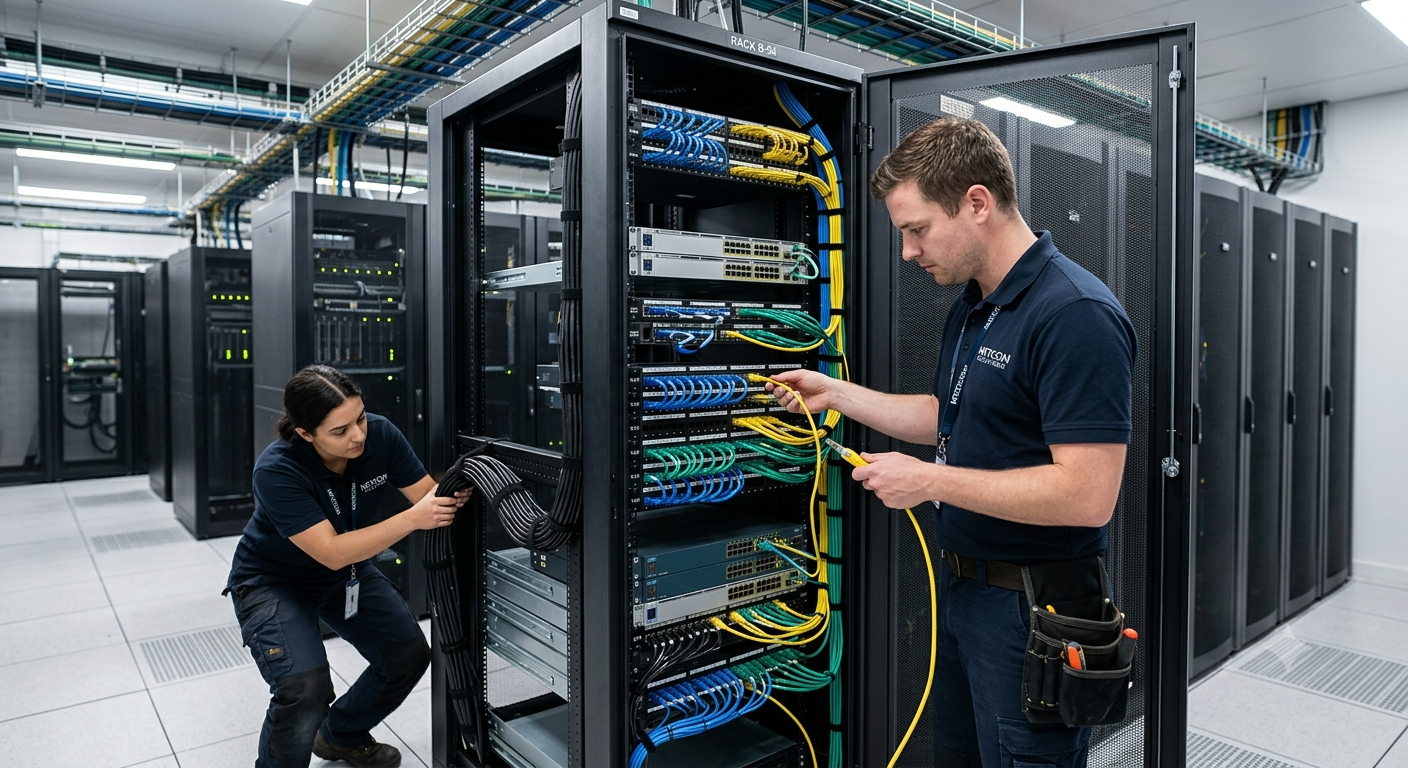
In the contemporary digital landscape, the structural foundation of enterprise IT environments hinges entirely on the integrity, physical architecture, and strategic organization of its server rooms and data centers. Structured cabling and precise hardware positioning are no longer viewed merely as tasks of aesthetic value; they are functional and operational requirements that dictate system uptime, thermal dissipation, and structural scalability. For modern systems integrators and engineering firms, such as Dam IT Solutions LLC, deploying enterprise infrastructure demands precise compliance with international standards, meticulously structured pathways, and optimal hardware positioning protocols.
Poorly executed installations and unstructured data lines introduce significant operational liabilities, including mechanical airflow restriction, severe signal degradation, delayed troubleshooting capabilities, and catastrophic physical strain on hardware components. Conversely, a standardized, systematic approach to cabinet configuration ensures immediate system adaptability, efficient heat management, and minimal Mean Time to Repair (MTTR) when network anomalies occur.
Phase 1: Comprehensive Site Assessment and Spatial Engineering
Before unboxing physical hardware or staging equipment, a rigid spatial analysis must be performed to guarantee structural compatibility, environmental stability, and compliance with local regulatory building codes. This preliminary stage establishes the parameters for load capacities, electrical paths, and thermal management strategies within the designated datacenter layout.
1. Weight Distribution and Floor Loading Calculations
Modern server enclosures packed with high-density compute nodes, uninterruptible power supplies (UPS), and storage arrays can easily exceed 1,000 kilograms (2,200 lbs) per footprint. Structural engineers must evaluate structural floor tolerances (expressed in kg/m² or lbs/sq.ft) to verify that both the raised flooring systems and the underlying concrete subfloors can support static and dynamic loads. Racks must be strategically positioned over primary floor stringers, utilizing heavy-duty leveling feet to distribute total mass safely across structural surface points.
2. Strategic Clearance and Safety Routing
Environmental guidelines, governed by ANSI/TIA-569 standards, dictate that server enclosures must have a minimum clearance of 36 inches (approx. 915 mm) at the front to permit standard equipment insertion and door swings, and 36 inches at the rear to provide field technicians sufficient space to execute connections and configure complex power distribution units (PDUs). A 48-inch aisle clearance is strongly recommended across hot/cold aisle layouts to maximize safety and airflow dynamics.
Phase 2: Enclosure Assembly, Placement, and Physical Anchoring
The structural stabilization of the enclosure provides the baseline security for all housed electronic systems. An unanchored or improperly balanced structural frame introduces dangerous kinetic hazards during hardware adjustments or seismic events.
1. Framing, Alignment, and Precision Leveling
Whether utilizing pre-assembled structures or modular flat-pack four-post open frames, technicians must implement precise leveling across both lateral and longitudinal axes using precision spirit or digital laser levels. Unbalanced cabinets create uneven torque across internal mounting rails, causing equipment binding, misaligned slide rails, and asymmetric physical load on the frame.
2. Structural Grounding, Bonding, and Safety Shielding
Electrical safety and equipment protection mandate that every chassis and equipment rack must be permanently bonded to the Building Grounding Equalizer (BGE). Utilizing dedicated copper grounding straps (typically 6 AWG or larger), technicians bond the cabinet frame directly to the main telecommunications grounding busbar (TMGB). This continuous pathway safely disperses stray electrostatic discharges (ESD) and prevents localized electromagnetic interference (EMI) from degrading clean signaling pathways. Standardized structural grounding minimizes operational risks, prevents random system logic locks caused by ambient static build-up, and protects valuable computational assets against unexpected high-voltage line anomalies, a benchmark standard implemented by Dam IT Solutions LLC.
Phase 3: Thermal Management and Airflow Optimization Architecture
The operational lifecycle of enterprise computing equipment drops significantly when subjected to sustained elevated temperatures. Implementing structured airflow models within server enclosures is vital to maintaining operational parameters and preventing hardware throttling.
1. Hot and Cold Aisle Containment Topologies
Enclosures must be organized to pull cool ambient air into the front intakes from a dedicated “cold aisle” and discharge thermal waste out the rear into a corresponding “hot aisle.” Mixing these air streams severely diminishes cooling efficiency. Technicians must seal all unoccupied rack units (U-spaces) with blanking panels. These inexpensive components block the hot exhaust air from looping back to the front intake, forcing it along the intended path toward the HVAC return ducts.
Phase 4: Structured Patching Infrastructure and Labeling Systems
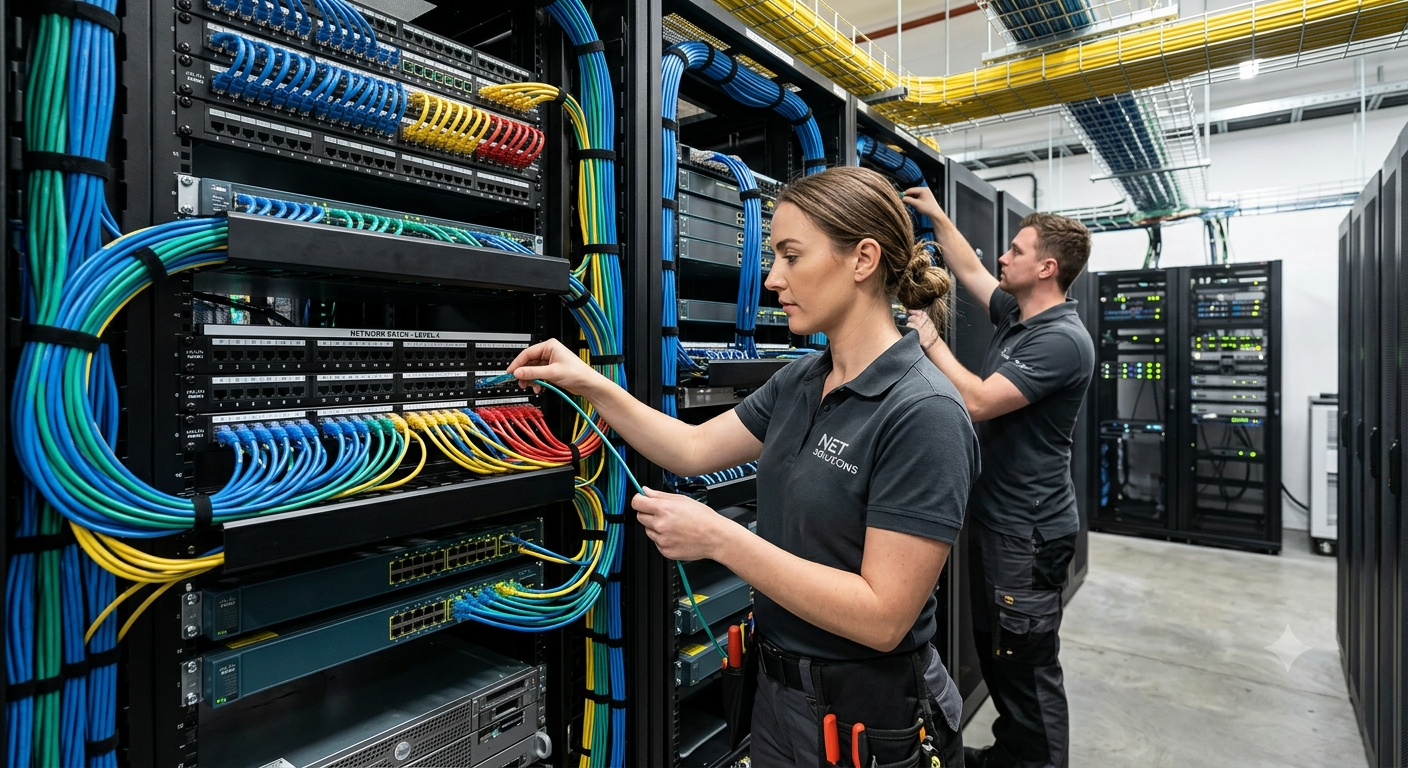
With the physical housing leveled, grounded, and cooled, the engineering focus transitions to the data layer. Patching infrastructure functions as the centralized routing network, connecting core distribution layers to edge nodes across the enterprise environment.
1. Horizontal and Vertical Cable Management Integration
High-density data systems require structured horizontal and vertical cable management systems to handle hundreds of specialized patch cables. Horizontal managers featuring deep finger-duct layouts should be installed directly above and below every patch panel. This placement prevents cable weight from pulling down on terminations, protecting copper or fiber connection blocks from tension fatigue and costly intermittent signal loss.
2. ANSI/TIA-606-C Compliant Labeling Frameworks
A network infrastructure is only as effective as its documentation system. Every single connection line, patch panel port, and equipment link must receive an unalterable, machine-printed label matching ANSI/TIA-606-C guidelines. Hand-written tape is unacceptable. Labels must clearly detail the source identifier, cabinet row, target rack unit, and terminal port number (e.g., RK02-U14-P01:RK05-U22-P24). This level of precision allows deployment technicians from teams like Dam IT Solutions LLC to isolate pathways in seconds, shifting operational maintenance from reactive guesswork to highly targeted servicing.
Phase 5: High-Performance Cable Management Protocols
Handling copper and fiber-optic media requires strict adherence to material physics. Mishandling physical layers can cause micro-fractures or high attenuation levels, degrading overall performance.
1. Maintaining Strict Bend Radius Standards
Copper data cables (Category 6, 6A, or 8) must never exceed their maximum bend radius guidelines—typically four times the external cable diameter during routing. For fiber-optic media, this requirement is even more critical, often requiring up to twenty times the outer jacket diameter under structural tension. Over-bending strains inner glass cores, causing macro-bending signal loss that ruins high-speed throughput links.
2. Securing Lines and Managing Tension
Plastic zip-ties should be avoided in data deployments because their narrow profiles can pinch internal copper pairs and deform internal insulation layers. This structural damage changes the cable impedance and causes near-end crosstalk (NEXT). Specialized hook-and-loop fasteners (Velcro straps) should be used exclusively. These fasteners secure cables snugly into structured bundles without compressing outer jackets, allowing for clean adjustments during future upgrades.
Phase 6: Testing, Comprehensive Validation, and Final Sign-off
Physical presentation and cable organization must be validated with objective data before infrastructure layers transition to live production status.
1. Copper Link Certification Testing
Every newly terminated Category 6A line must undergo rigorous qualification testing using calibrated field analyzers (such as a Fluke DSX series). Technicians run diagnostic profiles checking for Continuity, Wiremap Configuration, Insertion Loss, NEXT, and Return Loss up to 500 MHz. These metrics guarantee that the physical links can reliably handle 10GBASE-T data loads without packet loss.
2. Fiber-Optic Verification Testing
Fiber links require Tier 1 testing using an Optical Loss Test Set (OLTS) to verify total insertion loss falls within the calculated optical budget. For extended backhaul trunks, Tier 2 verification using an Optical Time-Domain Reflectometer (OTDR) is required to map line distance, identify splice loss points, and confirm zero structural damage exists along the path.
Conclusion: The Blueprint for Resilient Infrastructure
Investing in standardized rack installation and structured patching processes guarantees the long-term health, performance, and scalability of enterprise network infrastructure. By strictly adhering to these installation guidelines, computing architectures maintain optimal cooling, reliable physical connectivity, and clear pathways for future upgrades. For advanced implementations, choosing a vetted partner like Dam IT Solutions LLC ensures your corporate critical layers are designed to scale, keep systems operational, and match the speed of modern business demands.
