
The Architectural Backbone of Modern Enterprise: A Comprehensive Guide to Structured Cabling
Introduction: The Unseen Foundation of Digital Operations
In the contemporary corporate landscape, an organization’s digital infrastructure is directly tied to its competitive viability. While high-level software suites, cloud computing architectures, and sophisticated cybersecurity protocols dominate strategic business discussions, the physical layer responsible for carrying this critical data is frequently overlooked. In legacy environments, network infrastructure often evolves organically and haphazardly, resulting in an unmanageable tangle of point-to-point wiring known colloquially as “spaghetti cabling.” This disorganized approach introduces latency, complicates diagnostic troubleshooting, and creates severe performance bottlenecks that impede business growth.
To eliminate these operational vulnerabilities, forward-thinking enterprises rely on structured cabling. Structured cabling is a highly standardized, comprehensive engineering design that unifies an organization’s data, voice, video, and building management systems into a cohesive, modular network infrastructure. By adhering to rigorous international standards, a structured cabling deployment ensures predictable performance, minimizes system downtime, and establishes a robust foundation capable of supporting decades of technological innovation. For modern enterprises seeking to build or optimize this infrastructure, partnering with an expert technology integrator like Dam IT Solutions LLC guarantees that the physical layer is engineered precisely to maximize data performance and accommodate future operational expansion.
The Architectural Anatomy: The Six Subsystems of Structured Cabling
A compliant structured cabling framework is completely modular, segmented explicitly into six discrete subsystems. Each subsystem possesses distinct performance mandates, spatial boundaries, and hardware specifications as defined by the Telecommunications Industry Association (TIA) and Electronic Industries Alliance (EIA) standards.
1. Entrance Facilities (EF)
The Entrance Facilities represent the exact perimeter boundary where the external service provider’s network terminates and connects with the internal building infrastructure. This subsystem houses the physical structural penetrations, lightning protection apparatus, network interface devices (NIDs), and demarcation hardware. Proper engineering of the EF ensures that external data feeds are safely transitioned into the building’s distribution networks while maintaining code-compliant grounding and environmental seals.
2. Equipment Rooms (ER)
The Equipment Room is the centralized, environmentally controlled nerve center of the facility. It houses complex, high-density active electronics, including core enterprise switches, routers, servers, main cross-connects, and private branch exchange (PBX) telecommunications units. Unlike localized telecommunications closets, the ER demands highly specific environmental parameters, including precision HVAC climate control, dedicated uninterrupted power supplies (UPS), specialized fire suppression systems, and strict security measures.
3. Backbone Cabling (Vertical Distribution)
Often referred to as vertical cabling, the backbone subsystem serves as the core internal transit route for data within a building or across a multi-building campus environment. It establishes the critical high-bandwidth links between the main Equipment Room, the Entrance Facilities, and various localized Telecommunications Enclosures distributed across different floors. Because the backbone aggregates the data traffic of an entire facility, it relies heavily on high-speed single-mode or multi-mode fiber optic cabling (such as OM3, OM4, or OS2) to handle immense throughput demands without degradation over long distances.
4. Telecommunications Enclosures (TE) and Rooms (TR)
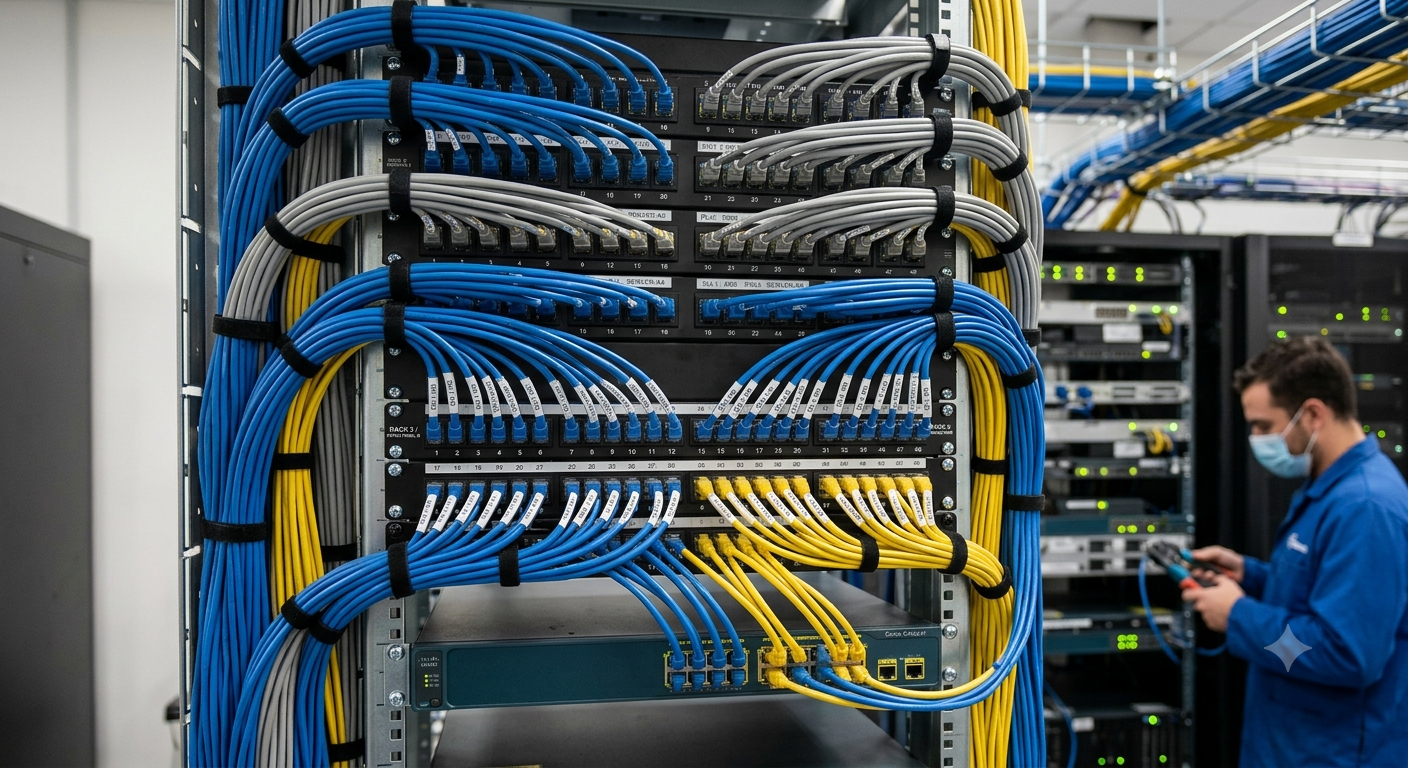
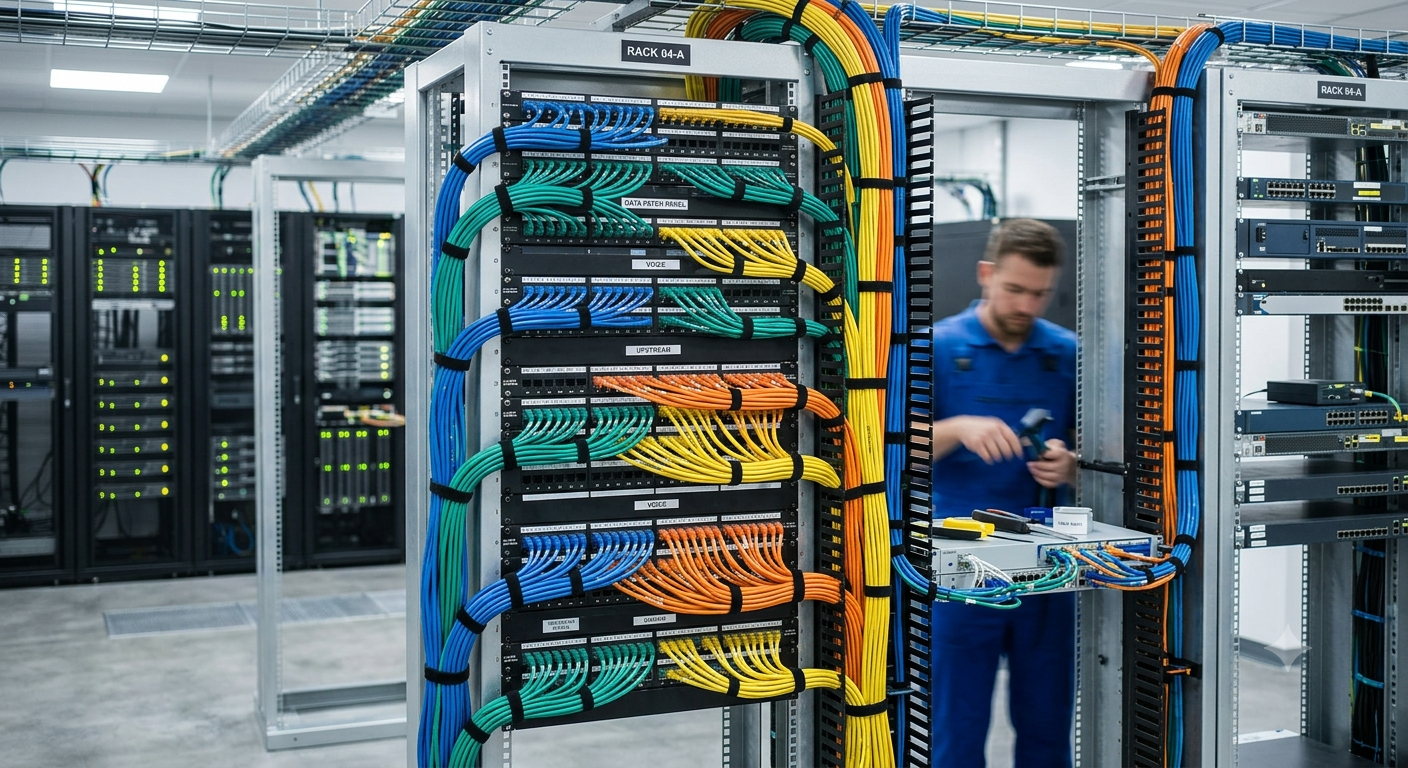
Telecommunications Rooms act as localized distribution nodes servicing specific architectural areas or individual floors of a building. These rooms contain localized patch panels, intermediate cross-connects, and horizontal switches that bridge the gap between the high-speed backbone cabling and the localized desk-level networks. Maintaining clean, labeled rack management within TRs is essential for efficient everyday network administration and rapid service restoration.
5. Horizontal Cabling (Horizontal Distribution)
Horizontal cabling extends outwards from the patch panels inside the Telecommunications Room directly to individual information outlets on the workspace floor. It is called “horizontal” because it typically runs along ceiling plenums, under raised floor systems, or through wall conduits on a single floor. This subsystem utilizes twisted-pair copper media (typically Category 6 or Category 6A) or localized fiber optics to connect individual users, wireless access points (WAPs), IP security cameras, and VoIP telephony units to the broader network matrix.
6. Work Area Components
The Work Area encompasses all final components that connect end-user equipment directly to the horizontal cabling outlets. This includes patch cords, modular jacks, faceplates, and adapters that interface with laptops, desktop systems, printers, and smart building sensors. While seemingly simple, using non-compliant or damaged patch cables at the work area is one of the most common causes of localized packet loss and network latency. Designing these six subsystems requires meticulous planning, precise distance calculations, and a deep understanding of local building codes. Enterprise networks trust Dam IT Solutions LLC to audit, design, and deploy compliant cabling layouts that function seamlessly as a single, unified communications platform.
Core Business Benefits: Why Structured Cabling is an Essential Investment
Migrating from unorganized point-to-point wiring to a standardized structured cabling architecture yields immediate operational advantages and provides long-term financial protection. It transitions a business’s network from an unpredictable liability into a high-performance asset.
1. Drastic Reduction in Operational Downtime
In a point-to-point network configuration, a single faulty cord can take hours or even days to isolate within a chaotic mass of identical cables. Conversely, structured cabling utilizes a clear, meticulously labeled organization system. This predictable modularity allows internal IT technicians or specialized deployment partners like Dam IT Solutions LLC to execute rapid fault isolation, run automated diagnostic tests, and replace faulty links in minutes, preventing costly operational disruptions and protecting corporate productivity.
2. Unrivaled Scalability and MAC Flexibility
Modern enterprises constantly undergo Moves, Adds, and Changes (MACs) as teams relocate, departments expand, or new hardware is integrated. In an unstructured environment, adding twenty new desks requires running entirely new lines from scratch, disrupting workspace workflows. A structured cabling layout pre-allocates localized consolidation points and horizontal pathways. Expanding your operational footprint or upgrading your physical hardware is as simple as plugging new patch cords into existing, pre-tested infrastructure ports.
3. Future-Proofing for Next-Generation Technologies
The rapid integration of Internet of Things (IoT) sensors, ultra-high-definition video conferencing, Wi-Fi 7 access points, and Power over Ethernet (PoE) smart lighting puts severe pressure on network bandwidth and power delivery. High-grade structured cabling (such as Category 6A shielded systems) provides the thermal stability, alien crosstalk mitigation, and 10 Gbps transmission speeds required to support tomorrow’s technological advancements without needing expensive infrastructure overhauls.
4. Superior Airflow and Reduced Facility Energy Costs
When server rooms and network racks are choked with tangled, unmanaged cables, they physically block the exhaust air pathways of server fans and active switches. This forced airflow restriction causes sensitive hardware to run abnormally hot, forcing data center HVAC units to consume massive amounts of energy to prevent catastrophic hardware meltdowns. Neatly arranged structured cabling clearing out pathways improves server cabinet thermodynamics, reduces active cooling expenses, and dramatically extends the operational lifespan of expensive core switches.
Industry Standards and Compliance: Engineering to Code
A structured cabling system is only as reliable as its compliance with international governing standards. True structured cabling installations adhere to strict criteria established by bodies such as ANSI, TIA/EIA, ISO/IEC, and local National Electrical Codes (NEC). These detailed regulations dictate parameters such as maximum cable runtime lengths (e.g., the strict 90-meter limit for copper horizontal channels), appropriate bend radii to prevent internal glass or copper fractures, and acceptable electromagnetic interference (EMI) clearance distances from high-voltage electrical lines.
Skipping these technical standards or cutting corners with substandard materials leads directly to signal degradation, data packet drop-offs, and potential legal building code violations. By engaging an industry-certified contractor such as Dam IT Solutions LLC, enterprises ensure that their entire network physical layer passes rigorous Fluke certification testing, meeting all performance, safety, and fire-resistance mandates before going live.
Conclusion: Securing Tomorrow’s Growth with Precision Today
Your physical layer is the literal highway system upon which every piece of enterprise data travels. Software applications will continuously update and hardware switches will be replaced every few years, but a well-designed physical cabling system should easily endure for 15 to 20 years. Investing in an organized, standard-compliant physical layer eliminates infrastructure bottlenecks, accelerates IT maintenance, and prepares your enterprise to rapidly adopt future technologies. Let the certified network infrastructure specialists at Dam IT Solutions LLC transform your physical infrastructure from a tangled operational risk into a sleek, high-speed corporate engine designed for sustained, scalable digital success.
